
Entirely new businesses have been built using data to disrupt traditional companies.

India SME Forum, an organisation for small and medium businesses, has called for creating a dedicated fund of Rs 5000 crore for the export capacity development, promotion, and marketing of Micro, Small & Medium Enterprises (MSMEs) in its Budget recommendation. The forum for MSMEs with over 98,000 members said that to enhance India's global competitiveness and increase its market share in global exports, it was "crucial to increase the number of active exporters and enable at least 3-4 lakh first-time micro, small, and medium exporters while supporting them in promoting Indian products globally."

A total of 35 persons have been arrested by the CGST authorities.

The governments of Karnataka, Uttar Pradesh and Rajasthan want a lower limit of Rs 100,00,00 gross annual turnover.
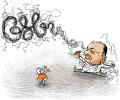
The window for registration is open up to September 30

India should convert the Trump threat to an India opportunity, re-embracing a more liberal trade regime as a way of reviving manufacturing output and exports.

From connectivity woes to infrastructure advancements and the startup boom, there is a gulf between claims and reality in India's economic landscape, points out Devangshu Datta.
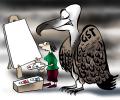
E-invoicing would be implemented on a voluntary basis by those having an annual turnover of above Rs 500 crore from January 1.

As Centre cedes power to states in indirect tax, it wants to all ystaffers' worry of little work.

Across 10 prominent services, revenue to the government reduced by 20 per cent in the first year of GST compared to the last year of the service tax regime. This happened despite tax liability against these services growing by 50 per cent in one year.

Headline growth was quite weak heading into the Covid period but averaged 6.4 per cent and 6.7 per cent in the five years between FY16 and FY20 for GVA and GDP respectively, points out Abhishek Upadhyay.

It was better to first build a single-rate GST with a low rate, achieve full mastery of this, and then consider more complex possibilities such as high rates and multiple rates.

Experts warn of over-interpreting the numbers and said their sustainability needed to be watched beyond November, says Indivjal Dhasmana.

The very design of the GST will bring in revenue buoyancy.

Despite a steady collection rate, the government faces a steep Budget target of Rs 6.1 trillion for CGST for 2019-20.

The revenue collection in the same month a year ago stood at Rs 94,442 crore.

He also said GST will take about a year to stabilise.

The finance ministry on Monday said it will transfer Rs 6,000 crore as the second tranche of GST compensation shortfall to 16 states and 3 Union Territories -- including Maharashtra, Bihar, Assam, Puducherry and Delhi. The Centre had on October 23 transferred Rs 6,000 crore to 16 states and 2 UTs of Delhi and Jammu and Kashmir. In the second tranche of transfer, Union Territory of Puducherry has been included.

Surplus liquidity in the banking system as measured by absorption of excess funds by the Reserve Bank of India (RBI) fell sharply at the end of the last week due to outflows on account of advance tax payments. According to the RBI data, the net liquidity absorbed by the central bank on September 16 was at Rs 3,243.57 crore, much lower than the average of Rs 56,809.92 crore in the preceding four days of the week. The average absorption of funds by the RBI so far in September is at Rs 1.13 trillion, against the average of Rs 1.2 trillion in the previous month, the data showed.
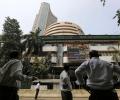
On the macroeconomic data front, PMI data on manufacturing and services sector will also influence trading

'The bull market cycle ran for five years. It's the end of that cycle.' 'The next cycle is a down cycle, and in that down cycle, you will see the Sensex falling from their highs of around 68,000 to maybe 40,000-50,000 at the bottom of the cycle.'

The central government's fiscal deficit during 2023-24 at 5.6 per cent of the GDP was better than previous estimates of 5.8 per cent on account of higher revenue realisation and lower expenditure, according to official data released on Friday. In actual terms, the fiscal deficit -- or gap between expenditure and revenue -- was Rs 16.53 lakh crore, or 5.63 per cent of the GDP, which grew 8.2 per cent in 2023-24.
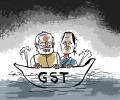
Retaining the GST rate assumes importance since states are under pressure to increase their revenues, hit hard by lockdown. Also, the Centre has not fully compensated states for their revenue losses on account of GST for 2019-20.

Tomato prices have been on the boil for more than a month. Data from major cities show that the spike has been between 125 and 150 per cent at the wholesale level. Soaring vegetable prices, including tomatoes, pushed the retail inflation rate to a nine-month high of 5.49 per cent in September, according to government data. Though reports say prices are expected to come down in the next few weeks after supplies improve from Madhya Pradesh and Himachal Pradesh, how long will the respite last is anybody's guess.
GSTN is planning a disaster recovery drill and hence services will not be available for 12 hours, between 9am and 9pm, on July 1, and has requested the taxpayers to plan GST-related activities on the portal accordingly.

'They think quick fixes like internship in the private sector will help. 'In fact, internships have been going on for the last one decade.' 'In 2014-2015 itself, we had a ministry of skill development. None of the programmes have yielded results, still they are continuing with such schemes under some other name.' 'We don't see any seriousness on the part of the government to attack the problem of unemployment.'

Its officers would wear black bands on Monday, which is also Martyrs day, the IRS Association (Customs and Central Excise) has said.

For the sake of transparency, and to reduce undesirable bond market volatility, clarity on these would be welcome, preferably before the budgets for the next fiscal year get finalised, says Neelkanth Mishra.
Since the present law threatens to unleash an avalanche of litigation over a period of time, it makes sense to replace it with a simpler law and build complexities as more experience is gained, says T N C Rajagopalan.

A total of 25,446 Chinese made electronic and Fast Moving Consumer Goods (FMCGs) were seized from the warehouse on Old Airport Road during the recent raids.
A road map could be laid out for a gradual reduction in the tax rates from the current incidence of about 62-94 per cent without causing a major blow to the revenues of the Centre and the states. The opportunity arising out of higher GST collections should not be squandered, says A K Bhattacharya.
In the current financial year, the Centre released nearly Rs 1 lakh crore compensation to the states till September.

He also pointed out that the home ministry was neither consulted, nor did it give the necessary security clearance

'The government should come back as a job creator as it did in the 1960s and the 1970s.'

Unincorporated enterprises in the manufacturing sector lost nearly 1.8 million establishments and shed 5.4 million jobs between July 2015-June 2016 and October 2022-September 2023, an analysis of the fact sheet on 'Annual Survey of Unincorporated Sector Enterprises (ASUSE)' and the comparable 73rd round survey in 2015-16 by the National Statistical Office (NSO) showed. An estimated 17.82 million unincorporated enterprises operated in the manufacturing sector in October 2022-September 2023, nearly 9.3 per cent down from 19.7 million unincorporated enterprises in July 2015- June 2016.

Macroeconomic data announcements, global trends and trading activity of foreign investors would guide momentum in the equity market this week, analysts said. Markets ended a five-week losing streak and gained nearly a per cent last week, helped by a sharp rebound on Friday. Last week, the BSE benchmark jumped 500.65 points or 0.77 per cent and the Nifty gained 169.5 points or 0.87 per cent.

The focus will be on tackling the unfinished agenda requiring immediate attention like tax structure for solar projects, uniform tax rate on state-organised and state-authorised lotteries, taxing non-potable alcohol besides certain changes in the law, extension for NAA and rate rationalisation.

Neutrality and jurisdiction in international trade need to be discussed threadbare before GST is implemented in India.

The 50-share NSE Nifty ended flat, up 5.80 points, or 0.06 per cent, at 10,308.95.
The Centre's revenue from GST registered a decline of 10 per cent in 2017-18 compared to revenue of subsumed taxes in 2016-17.
